



The short answer
If you default on an IRS installment agreement, you usually have 30 days from the date on Notice CP523 to fix it before the IRS ends your plan. After termination, the IRS can levy your wages, bank accounts and other assets. In most cases you can reinstate the plan by catching up on missed payments, paying any new tax due, and paying a revision fee.
[Editor's note: This article was published in 2012 and has been updated for accuracy and comprehensiveness.]
What to Do After Defaulting on an IRS Installment Agreement
Key facts (as of October 2026):
- What triggers default: a missed payment, a new tax balance you don't pay, an unfiled return, or not giving the IRS updated financial information when asked.
- The warning notice: CP523, the IRS's "intent to terminate your installment agreement and seize (levy) your assets" letter.
- Your deadline: contact the IRS within 30 days of the notice date.
- Reinstatement cost: $6 online or $89 by phone, mail or in person ($43 for low-income taxpayers, which may be reimbursed).
- Penalty jump: the failure-to-pay penalty is 0.25% a month during an approved plan. It returns to 0.5% if the plan ends, and rises to 1% once a levy notice goes unpaid for 10 days.
- Appeal option: you can challenge a proposed or actual termination through the Collection Appeals Program with Form 9423.
What counts as defaulting on an IRS installment agreement?
You default when you break any term of the agreement, not only when you miss a payment. The Internal Revenue Manual (IRM 5.14.11.3) lists these triggers:
- A missed or short payment. Paying less than the agreed monthly amount, or paying late, counts.
- A new tax balance. If you owe on next year's return and don't pay it in full, your existing plan can default. This is the most common surprise for self-employed people and anyone whose withholding is too low.
- An unfiled return. Every agreement requires you to file all future returns on time.
- Ignoring a request for financial information. The IRS can ask for an updated Collection Information Statement (Form 433-A or 433-F) at any time.
- Inaccurate information. If the financial details you gave to get the plan were incomplete or wrong.
- Not paying a revised amount. If the IRS adjusts your payment based on new financial data and you don't pay it.
A drop in income doesn't cause default on its own. It becomes a default only when it leads to a missed payment; so make sure you're communicating with the IRS before that happens.
What happens after you default?
The IRS gives you a window to fix the default before it ends the plan and moves to enforced collection.
- Notice CP523 arrives by certified mail. It says the IRS intends to terminate your agreement and levy your assets. You have 30 days from the notice date to act.
- The agreement is terminated if you don't respond. You then have another 30 days to appeal the termination.
- Levy protection ends. Under current IRS rules, the IRS won't levy the periods in your plan for 90 days after mailing the CP523. After that, it can garnish wages, take bank funds and seize other assets.
- Other collection steps can follow: a Notice of Federal Tax Lien, refund offsets, and passport certification if your total debt tops $66,000 in 2026. Debt being paid through an approved, current installment agreement is not certified, so keeping the plan alive protects your passport.
- Costs rise. Interest keeps accruing at 7% a year (Q4 2026, compounded daily). The failure-to-pay penalty loses its 0.25% plan rate and can climb to 1% a month after a levy notice.
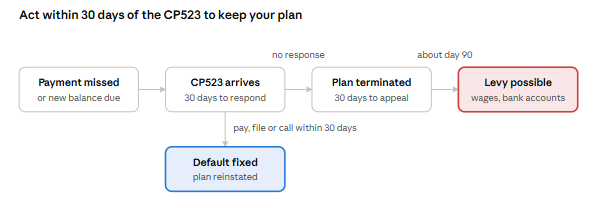
Fixing the default inside the CP523's 30-day window keeps your plan; waiting moves you toward termination and levy.
How to fix a defaulted IRS payment plan, step by step
- Read the notice and note the date. Your 30 days run from the date printed on the CP523, not the day you opened it.
- Find out why you defaulted. A missed payment, a new balance and an unfiled return each need a different fix.
- Fix the cause. Make the missed payment, file any missing return, or pay the new balance. The IRS may require you to pay a new liability in full before it reinstates the plan.
- Reinstate the plan. If you qualify, log in to your IRS Online Account and choose "Reinstate after default." Otherwise, call the number on your notice.
- Ask for a lower payment if you need one. You can change the amount and due date when you reinstate. Owing over $50,000, or wanting a payment below the standard amount, usually means filing a financial statement (Form 433-F or 433-A).
- Switch to direct debit. Revising an existing direct debit agreement costs $0, and automatic payments are the simplest way to avoid another miss.
- Appeal if the IRS refuses. File Form 9423 for a Collection Appeals Program (CAP) hearing within 30 days of the proposed termination, or within 30 days after the actual termination.
- Get help for complex cases. A tax professional can deal with the IRS for you under Form 2848. Low-income taxpayers can contact a Low Income Taxpayer Clinic.
Reinstatement and revision fees (As of 2026)
|
How you reinstate |
Standard fee |
Low-income fee |
|---|---|---|
|
Online account |
$6 |
$6, may be reimbursed |
|
Phone, mail or in person |
$89 |
$43, may be reimbursed |
|
Changes to an existing direct debit plan |
$0 |
$0 |
Source: IRS Payment plans. The IRS notes you "may incur a reinstatement fee" when a defaulted plan is restored.
Can you always reinstate?
Not automatically. According to the IRS, IRS staff can reinstate without manager approval when the plan meets streamlined criteria and you haven't defaulted in the past 12 months. Repeat defaults usually mean a full financial review before you get a new plan.
What if you can't afford any payment plan?
If your finances changed so much that no installment amount works, a payment plan may not be the right tool anymore. These options are worth comparing:
|
Option |
Best for |
What to know |
|---|---|---|
|
You can't cover basic living expenses |
Collection pauses, but interest and penalties keep growing, refunds are kept, and a lien may be filed |
|
|
You can pay something, but not enough to clear the debt before the collection deadline |
Requires a full financial statement; any balance left when the 10-year collection period ends is no longer collectible |
|
|
Your assets and future income can't realistically cover the debt |
$205 fee plus an initial payment, both waived for low-income filers; uses Forms 656 and 433-A (OIC) |
|
|
Penalty relief (First-Time Abatement or reasonable cause) |
You have a clean history or a good reason for falling behind |
Removing penalties lowers the balance and the monthly payment |
|
Collection Appeals Program (Form 9423) |
You think the IRS terminated your plan wrongly |
Must be filed within the CAP deadlines; collection on the plan periods generally waits during the appeal |
One more point: the 10-year collection clock keeps running while a plan is in effect, but it pauses for 30 days when the IRS proposes to terminate a defaulted plan and during any appeal.
How to avoid defaulting again
- Use direct debit. Set it up online, on Form 9465, or with Form 433-D. It also lowers your setup fee and lets you change terms for free.
- Fix your withholding or estimated payments. A new balance due is a leading cause of default. Use the IRS Tax Withholding Estimator or make quarterly estimated payments if you're self-employed.
- File every return on time, even when you can't pay the tax on it.
- Pick a realistic payment. A smaller payment you can keep up beats a larger one you'll miss.
- Call before you miss. You can revise your amount or due date online before a payment is late. That's cheaper and simpler than reinstating after default.
- Open every IRS letter right away. Every deadline in this process runs from the notice date.
Frequently asked questions
Does one missed payment default an IRS installment agreement?
Yes, technically. But the IRS sends Notice CP523 first and gives you 30 days to catch up before it terminates the plan.
How long do I have to fix a defaulted payment plan?
Usually 30 days from the CP523 notice date. If the plan is terminated, you have another 30 days to appeal through the Collection Appeals Program.
Can I reinstate my IRS payment plan online?
Often, yes. Individuals can choose "Reinstate after default" in their IRS Online Account. The fee is $6 online versus $89 by phone or mail.
Will the IRS levy my bank account if I default?
It can, once the plan is terminated. The IRS generally won't levy the periods in your agreement for 90 days after it mails the CP523, which gives you time to fix the default or appeal.
What happens if I owe taxes on next year's return while on a payment plan?
A new unpaid balance can default your plan. Pay it in full by the due date, or contact the IRS to add it to your existing agreement before you receive a default notice.
Does defaulting affect my credit score?
The IRS doesn't report to the credit bureaus. However, a Notice of Federal Tax Lien is a public record that lenders may find.
Can I get a new payment plan after defaulting?
Usually. Repeat defaults within 12 months often mean the IRS will require a full financial statement before approving a new plan.
Get help with a defaulted IRS payment plan
A default isn't permanent, but the 30-day window goes fast. If you've received a CP523 or your plan has already been terminated, talk to one of our tax experts your options by scheduling a free consultation.
